This article was originally published on kinematografia-shqiptare-sporti.com on November 2, 2021.
It features a 2009 interview with Agim Zajmi, People’s Painter, reflecting on theatre as his lifelong artistic home.
Learn more about Agim Zajmi in his biography.
“The Theatre Is My Home”
Agim Zajmi has worked as a scenographer on theatre stages, with his most recent project being the scenography of the premiere performance A View from the Bridge. For him, theatre is more than life itself. He collaborated with many directors, leaving an indelible mark as a scenographer on theatre stages. Although he regrets that the years have passed and may have brought some fatigue in his profession, he continues to state clearly that theatre is his home.
Agim Zajmi was born in Tirana on November 28, 1936. He completed his higher studies in painting and scenography in 1961 in Saint Petersburg, Russia. Since that year, he worked as a scenographer at the Opera and Ballet Theatre, later mainly at the National Theatre in Tirana, and periodically at theatres in Skopje and Kosovo. In 1978, he was appointed professor at the Academy of Arts in Tirana. His paintings have been exhibited in many countries, including France, Italy, Egypt, and the United Kingdom.
His works in painting are part of the collections of the National Art Gallery, while others are held in private collections around the world. As a scenographer, he participated in numerous international theatre festivals. He is the recipient of many national awards in painting and scenography. In 1991, he was awarded the title “People’s Painter.”
You have been involved in theatre scenography for many years. In which year did you begin your career as a scenographer?
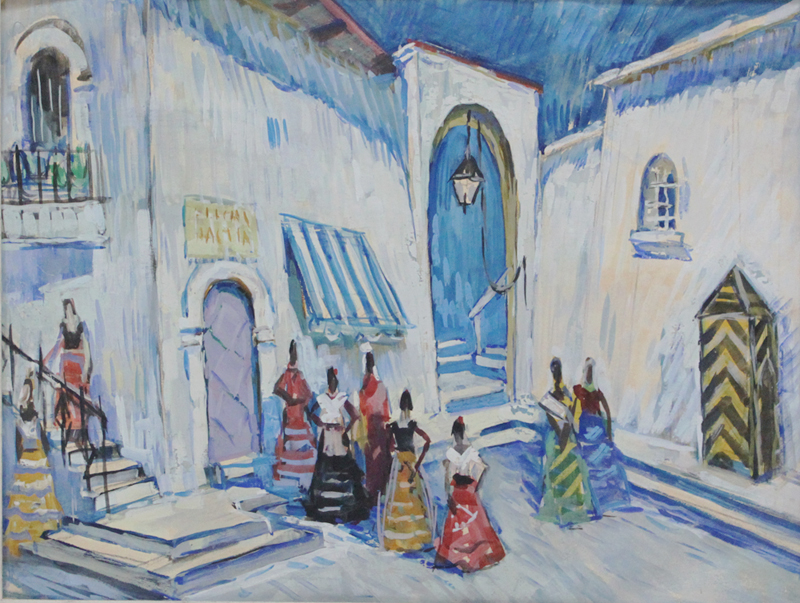
My career began in 1961 with the opera Carmen on the stage of the Opera and Ballet Theatre. At first, I spent two years working in opera, and later I moved to the National Theatre, which at that time was more developed. I was happy to work in theatre because it had a cultural level that was beneficial for everyone. When you work in a highly cultured and literary environment, rich and respectful in human relations, you feel fulfilled.
Unfortunately, today there is a certain coldness. Theatre used to always remain theatre, without being mixed with politics, and for me it has always been theatre. Theatre becomes beautiful even with simple elements when you love it. But for me, theatre itself must be revitalized, must generate living artistic activity, and must bring people to the stage as often as possible. In the past, the audience would attend the same performance three or four times; today, they come only once.
We must consider that Tirana at that time had around 200,000 inhabitants, whereas today it has nearly one million, yet the number of stages has not increased accordingly. That is why theatre must seek itself and not look elsewhere. If theatre exists, it must choose good works that interest the public, not works that lack relevance. I am against slang and street theatre; if they exist, let them exist, but the intrusion of vulgar, erotic, and uncultivated tendencies has no place on this stage.
How do you understand theatre when viewed through the eyes of a scenographer who has worked on stage for many years?
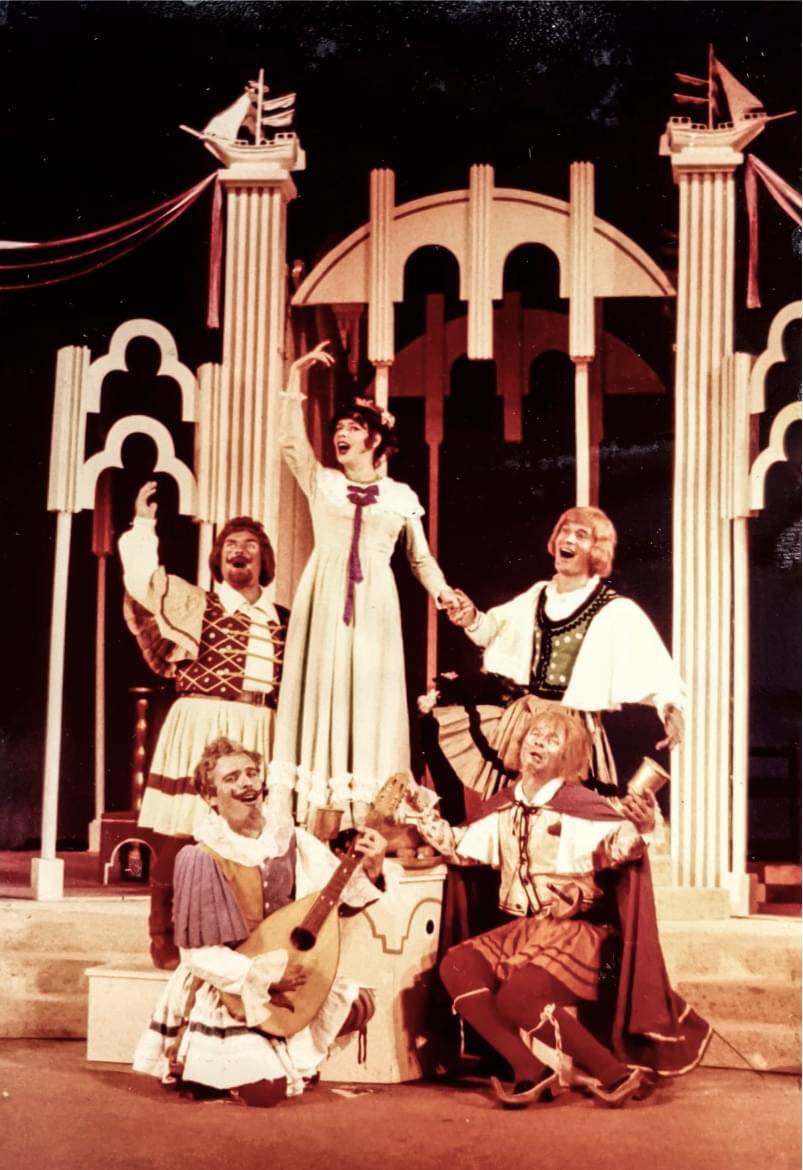
Theatre is a collective art. Many people work for it, from the invisible administrators to the simplest backstage workers. These are the unseen heroes who are not visible, yet without them a performance cannot exist. Starting from the true concept of art that I embrace, I have always relied on the work being staged. For example, Shakespeare is one of the most renowned figures and serves as a foundation; however, what exists in one play does not exist in another, because creators differ, starting with the scenographer and the author—who are in fact three, since the author exists only through others.
At that time, communication developed between the two individuals who conceptualize the performance: the director and the scenographer. It must be said that in theatre the director must be 100% a director, of which 50% must be scenography. Conversely, the scenographer must be 100% a scenographer and 50% a director. This organic bond is essential for a performance. Without it, the performance would fail.
Actors are interpreters; without diminishing their creative value, their foundation lies in what someone else has written. The director and the scenographer are abstract creators; they can be seen, for example, in A View from the Bridge, and we must accept that in many places around the world, the scenography of performances is created in many different forms.
This is one variant in which I believe—without modesty—that at the age of 71, this may be among the better versions, in which the scenography of this performance is placed on another stage. Nevertheless, I cannot say that this is the final word or that others will not do it differently. It is made for our theatre, within the conditions of this stage, because its space is very limited.
Here I must mention the stage of the Academy, which has a depth of ten meters, whereas this one has only eight. Still, we have learned to work economically and to bring something beautiful that also pleases the audience.
You have created scenography in two different periods in terms of the development of theatre in the country. How do you see the difference between them?
I believe that in that earlier period, there was truly theatre, actors, directors, and scenographers. By contrast, today, from culture to craftsmanship, there has been more growth, even though today’s audience has distanced itself more from the theatre stage.
You said that today the audience is distant from theatre. Why did this happen?
Theatre itself is responsible for the distancing of the audience because it is no longer a repertory theatre, where performances ran only on Mondays, while from Tuesday to Sunday there was daily activity that kept the audience connected and informed. Today, when theatre is abandoned for long periods, people forget about it.
At that time, theatre stayed alive through tours and frequent performances, which kept people engaged and reminded them of its presence.
Let us move to the performance A View from the Bridge. Could you tell us something about its theatrical concept?
For me, this is a clean performance. The concept is detached from the theme of emigration, because that is not the conflict. The conflict is a family psychological drama in which the character Eddie Carbone is presented in two dimensions: first as an honest man who sacrifices himself, and second as a man with a strong temperament and jealousy that is justified within the play.
This is constructed in such a way that this character, with Balkan jealousy and such a temperament, reasons logically. He is not aggressive in the way we unfortunately see today in our country, where murders occur that cannot be justified solely by temperament. Certainly, such acts are condemned immediately, but here there is a logic: he sacrifices himself for the girl, and his jealousy is not because he desires her, but because he sacrifices for her as for his own child.
This is justified because he is an honest and pure man; he lived honestly and is not what one might think, because he kills himself in the end. This is a very beautiful construction by the director, because it becomes clear in the play that Eddie kills Marco. In the play, the goodness of his character stands out.
You are the scenographer of this production. How did you construct its set, and what are its distinctive characteristics?
There is a set of a particular nature. It is one of those sets for which it can be said that scenography is born and dies within the performance. This scenography will be remembered for this production.
From an artistic standpoint, it is built with a simple conventional language. Although the play is realistic, this does not mean that convention is not realistic. Convention means expressing something in the simplest language possible, without overload.
The theatrical work is divided into three premises, which I attempted to connect organically, rather than allowing them to stand apart. There was an idea that it could be done through rotation, but that would have created confusion for us, whereas here events unfold before the audience’s eyes.
I am in favor of a theatre that demonstrates everything to the audience in a different way. Let the viewer see that this is a set, that this is a chair. Theatre is more than life because it synthesizes what life itself is. In life, things are ordinary; in theatre, things acquire a different power.
A few days ago, the theatre festival “Teatri Rinor” was held, and you participated in some of its performances. What is your opinion on how these performances were conceived scenographically, considering they were staged by young people?
In fact, I did not follow all the performances, but I believe that there are talented young women and men. Certainly, under the conditions of this festival, the possibilities were limited, with a minimal budget, and all components of the performance were forced to revolve around that budget. These young people are talented and must be activated.
How do you see the development of theatre scenography over the past 17 years?
Theatre scenography does not have the grandeur of concert festival stages. However, it is much more difficult to work with because it involves many problems that do not exist there. Scenography has progressed well toward a form of convention.
If it is intended for the audience, 80% must be realistic. I have tried this, and I am a scenographer by nature who accepts convention in theatre and contemporary scenography, but with restrained thinking—not extravagant.
I want to live together with the troupe in such a way that this scenography becomes a shared spirit with the author, the director, and the actors. However, we face a problem of outdated equipment. These are the same old possibilities; nothing has been added. Nevertheless, we try to create with the means we have. In our country, the contemporary concept functions well, while the material level does not correspond to what it should be.
When Professor Agim Zajmi looks back, what does he see in his career?
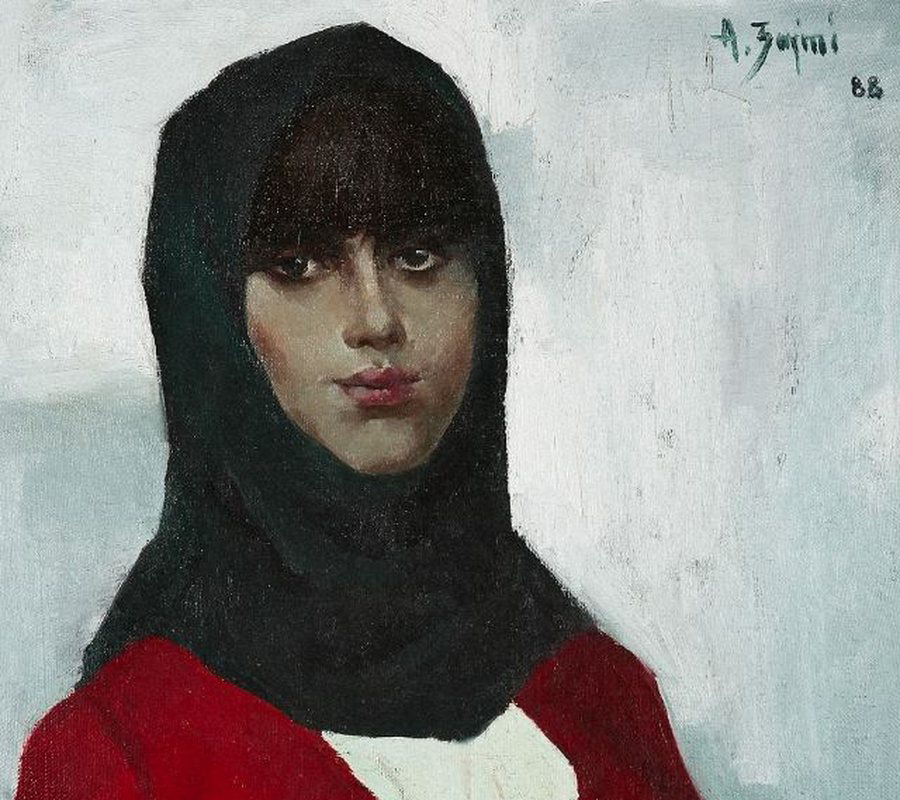
I regret having done so much stage design because more than 300 performances have passed, and sometimes I forget that I am also an easel painter and have done just as much work in painting. It is work that I did with pleasure, and I say this with humor, because for example, one evening an inspector came, and I forgot that I had worked—only when I heard that I had worked did I wish I had worked less.
Perhaps it is better that I worked so much that I do not know how to explain it otherwise. But I am not saying that I am leaving, because it is not appropriate; rather, I am at a stage where I must return more to individual art, to painting, because it is an independent art.
At a certain age in theatre, there is also fatigue with people, because many things happen.
With humor, I end this conversation by telling Pirro Mani that I worked with him on all our performances. When I was young and entered the stage, it was empty, and I was afraid—afraid of what I would do, because it had to be transformed differently from how it appeared. Now, having removed that modesty, when I enter the stage, it is the stage that is afraid of me.
Reference: Tirana Observer — 2009
For further information regarding available works by Agim Zajmi, please feel free to contact us.