This article was originally published in Anglisticum Journal (IJLLIS), Volume 4, Issue 9, September 2015.
The full article can be accessed via the Meliti Media archive (pdf)
Written by Erald Bakalli, Rector of the University of Arts in Tirana, Albania, it reflects an academic and critical perspective on the development of Albanian scenography and highlights the contribution of painter, scenographer, and professor Agim Zajmi.
Learn more about Agim Zajmi in his biography.
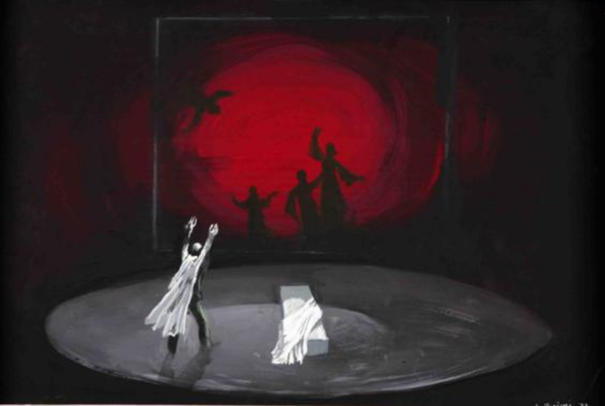
…In his analysis of the evolution of scenographic language in Albania, Bakalli emphasizes the artistic and structural importance of Agim Zajmi’s work, particularly in the National Theatre production of “Gjenerali i ushtrisë së vdekur” (The General of the Dead Army). He notes that Zajmi’s scenographic solutions were both visually monumental and functionally precise, offering practical opportunities for expressive actor movement. In the wedding scene, the décor was constructed on two levels, visually reinforcing the psychological and symbolic tension between opposing worlds. The elderly women, including the central figure of Nica, occupied the upper level, while the wedding guests were placed below. The General and the Priest were positioned diagonally, creating a powerful visual confrontation. This spatial composition highlighted the emotional intensity and symbolic hierarchy of the scene, making the scenography an active component of the dramatic expression.
Bakalli further explains that Zajmi’s scenography enabled dynamic visual construction and reconstruction, maintaining a meaningful and functional relationship with the actor. His work was not merely illustrative, but conceptual and expressive, contributing directly to the theatrical language.
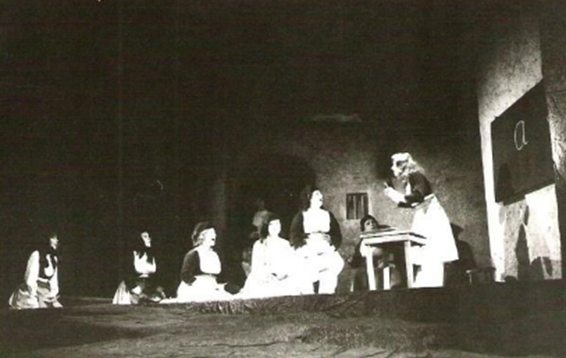
In the production “Cuca e Maleve,” Zajmi’s scenographic vision conveyed profound symbolic meaning through minimal elements. Against the austere grey background of the mountains, he introduced a simple interior space with a blackboard displaying the letter “a.” This visual gesture symbolized the emergence of knowledge and enlightenment in remote mountainous regions, transforming a harsh environment into a poetic and meaningful artistic statement. The scenography did not imitate reality, but captured its essence, expressing the core idea through artistic convention.
According to Bakalli, scenography must not function as a passive or illustrative element, but as an essential artistic language. It embodies the scenographer’s visual thought and conceptual interpretation, contributing to the unity of the theatrical work. In this context, Agim Zajmi’s work represents a major contribution to the professional and artistic development of Albanian scenography, distinguished by its clarity, symbolism, and expressive power…
Reference
Bakalli, Erald. Aesthetics of Scenography Development. Anglisticum Journal (IJLLIS), Volume 4, Issue 9, September 2015. University of Arts, Tirana, Albania.
For inquiries regarding available works by Agim Zajmi, please contact us.